A restaurant experience begins before the first order is placed. For many guests, the journey starts with choosing a restaurant and securing a table, followed by arriving, exploring the menu, placing an order, requesting assistance, and finally settling the bill. Every step contributes to how guests perceive the restaurant.
For restaurant owners, managing this entire journey efficiently can be challenging. Staff need to keep track of tables, orders, kitchen requests, customer needs, and payments while maintaining good service. When these activities depend heavily on manual coordination, delays and missed requests can affect the overall dining experience.
Technology is changing how restaurants manage these interactions. AI for restaurants can connect different parts of the guest journey and help teams provide faster, more consistent service without removing the human side of hospitality.
The Restaurant Guest Journey Is More Than Taking an Order
A successful dining experience involves several connected stages. Guests need to move smoothly from one step to another without unnecessary waiting.
A typical journey can include:
- Finding and booking a table
- Arriving and being seated
- Viewing the menu
- Understanding dishes and making choices
- Placing an order
- Requesting additional assistance
- Receiving food and other services
- Asking for the bill
- Completing payment
Each stage creates an opportunity for restaurants to improve convenience. At the same time, each stage can create operational pressure when staff have to manage everything manually.
AI-powered restaurant technology can help connect these touchpoints so that information moves more efficiently between guests, restaurant staff, the kitchen, and management.
Making the Table Experience More Connected
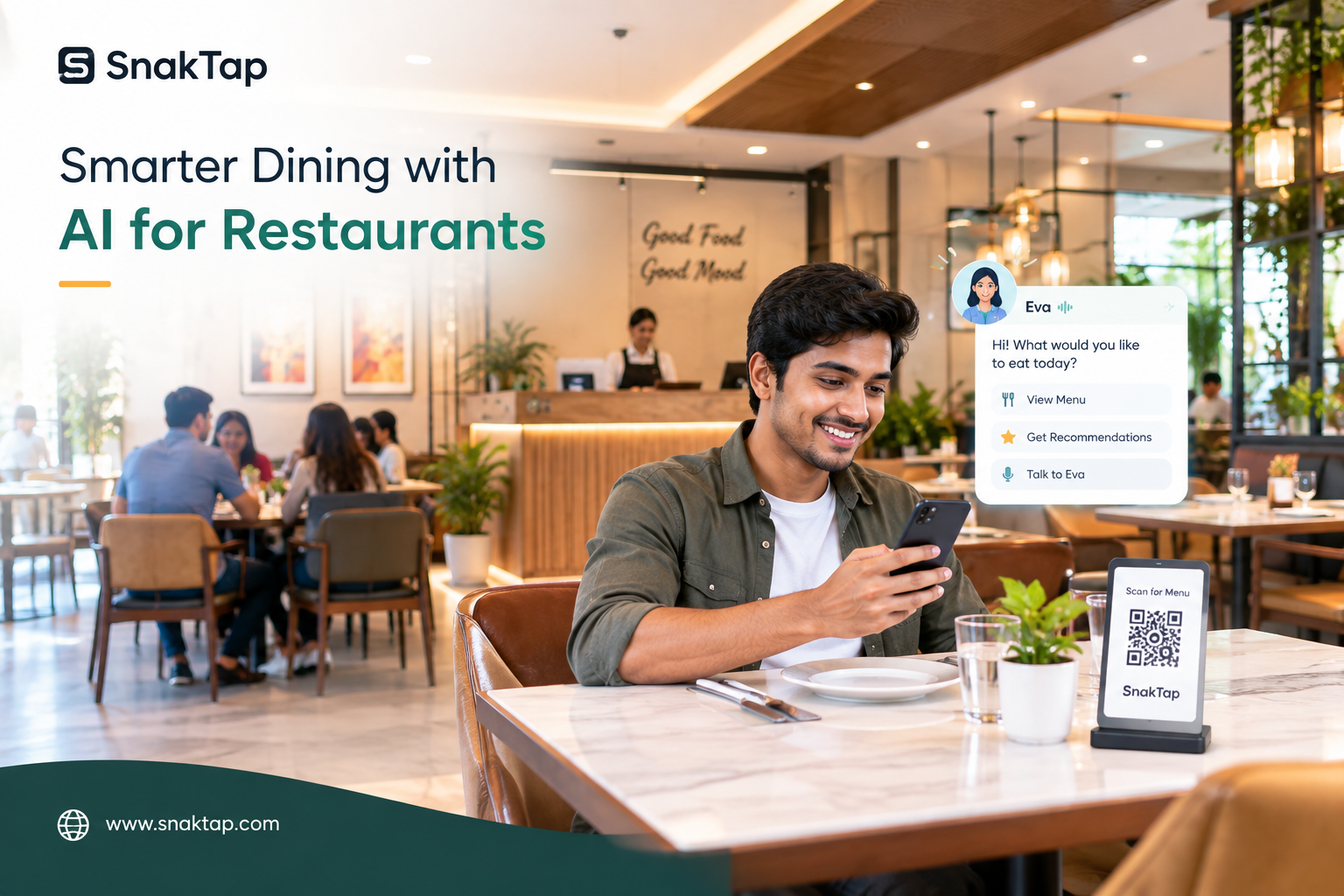
Once guests are seated, one of the first things they need is access to the restaurant’s menu. A QR code for restaurant menu allows guests to scan directly from their table, explore the available dishes, and place orders without waiting for a physical menu or a staff member to take the initial order.
This approach gives guests more control over when they begin browsing and ordering.
For restaurants, digital menus also make it easier to keep menu information current. SnakTap’s restaurant platform allows restaurants to update dishes, prices, availability, and offers so guests can see the latest menu information.
From Digital Menu to Guided Decision-Making
A digital menu can make ordering more convenient, but simply displaying menu items is only one part of the experience.
Guests may still have questions such as:
- Which dish is suitable for their preference?
- What should they order with a particular dish?
- Are there complementary items worth considering?
- What could they add to their order?
This is where an AI waiter can add another layer to the dining experience.
How an AI Waiter Can Assist Guests
SnakTap’s EVA is designed as an AI waiter that helps guests discover dishes, answer questions, and recommend relevant add-ons based on their order.
Instead of requiring guests to browse every item independently, an AI-assisted experience can make the decision-making process more interactive.
For example, when a guest is considering a particular dish, EVA can recommend complementary items that fit the order. This creates an opportunity for relevant recommendations while allowing the guest to make the final choice.
The purpose is not simply to automate communication. It is to make the ordering process more useful and convenient for the guest.
AI Can Support Ordering Beyond the Table
The guest journey does not always begin after someone sits down. Restaurants also receive orders and enquiries through other channels.
This is where technologies such as restaurant voice AI can become relevant. Voice-based AI can provide another way for restaurants to handle customer interactions and ordering-related communication.
Similarly, restaurant phone order AI can support restaurants that receive orders or enquiries through phone calls.
For restaurant owners, the broader idea is to create a connected ordering experience rather than treating every customer interaction as a separate process.
Different ordering channels can serve different customer preferences, while the restaurant still needs an organised system for managing the resulting orders.
Keeping Tables and Orders Visible to Restaurant Teams
The guest experience also depends on what happens behind the scenes.
Restaurant staff need to know which tables are available, occupied, active, or ready for payment. SnakTap’s live table board provides this visibility in one place.
1. Live Table Status
A central table view helps restaurant teams understand what is happening across the floor.
Instead of depending entirely on verbal updates, staff can see table activity and respond according to the current status.
This becomes particularly useful during busy periods, when several tables may be ordering, waiting for food, requesting assistance, or preparing to settle their bills at the same time.
2. Orders and Kitchen Coordination
Once a guest places an order, the next important step is getting the right information to the kitchen.
SnakTap’s Orders & KOT workflow moves orders from the table to the kitchen with the relevant details. This helps keep the ordering and preparation process connected.
The objective is straightforward: reduce unnecessary gaps between the guest placing an order and the kitchen receiving the information needed to prepare it.
Handling Guest Requests Without Unnecessary Waiting
Ordering is not the only reason guests need restaurant staff.
During a meal, a guest may need water, assistance, the bill, or another service. SnakTap’s guest-request functionality allows guests to request services and generates staff alerts.
This can make the interaction more organised because restaurant teams can see requests rather than depending solely on guests trying to get a waiter’s attention.
For guests, the benefit is convenience. For staff, the benefit is greater visibility into what different tables need.
Moving From Order to Payment
The final stages of the dining experience are just as important as the beginning.
After guests finish their meal, they need a clear and convenient way to settle the bill. Delays at this stage can affect the overall impression of an otherwise smooth dining experience.
SnakTap brings payments and billing into the same restaurant workflow. Its platform allows restaurants to manage bills, payments, and completed orders without switching between multiple systems.
A More Connected Billing Process
When table activity, orders, and payments are connected, restaurant teams can more easily understand the current state of each table.
A table can move from active dining to ready for payment and finally to a completed transaction.
This creates a clearer operational flow:
Table → Menu → Order → Kitchen → Guest Service → Bill → Payment
Connecting these stages can help restaurant teams maintain better visibility throughout the guest journey.
How Restaurant Owners Can Use the Data Behind the Journey
The value of connected restaurant technology does not end when a payment is completed.
Restaurant owners also need to understand what is happening across their business.
SnakTap’s live dashboard provides visibility into orders, revenue, sales, and restaurant activity. Its sales analytics provide information about revenue, order volume, average order value, and overall restaurant performance.
Understanding What Guests Prefer
Customer insights can also help restaurants understand their guests, including their orders and visits.
This information can support better decisions about the overall guest experience.
For example, understanding which dishes are driving orders and which products are performing strongly can help restaurant operators identify what is working well.
SnakTap also provides top-selling item insights, allowing restaurant teams to see which dishes are contributing to orders and revenue.
The Role of AI in the Modern Restaurant Experience
AI does not need to replace restaurant staff to be useful.
Its role can be to support repetitive interactions, improve information flow, provide relevant recommendations, and give restaurant teams better visibility into operations.
From an AI waiter helping guests discover dishes to digital ordering, live table management, kitchen workflows, guest requests, billing, and restaurant analytics, connected technology can help reduce friction across multiple stages of the dining experience.
The important point is that these capabilities work best when they contribute to one connected journey rather than operating as isolated tools.
Creating a Smoother Guest Journey
For restaurant owners, improving guest experience is not necessarily about adding more technology. It is about using technology where it solves genuine operational problems.
A well-connected restaurant experience can allow guests to:
- Access the menu easily.
- Explore dishes independently.
- Get assistance when they need it.
- Receive relevant recommendations.
- Place orders directly from the table.
- Request additional services.
- Complete their bill and payment.
- Enjoy a smoother overall dining experience.
At the same time, restaurant teams can maintain visibility over tables, orders, kitchen activity, payments, sales, and customer information from connected restaurant systems.
Final Thoughts
The restaurant guest journey does not end when an order is placed. From the moment a guest interacts with a restaurant to the moment the bill is settled, every interaction can influence the overall dining experience.
AI and connected restaurant technology can help make these interactions more organised and convenient. Digital menus can simplify access to information, AI waiters can assist with recommendations and questions, live table management can improve operational visibility, and integrated billing can make the final stage of the experience more efficient.
For restaurant owners, the goal is not simply to introduce AI. It is to create a connected experience in which guests receive timely assistance while restaurant teams have the information they need to operate effectively.
As restaurant technology continues to evolve, platforms such as SnakTap demonstrate how ordering, guest assistance, table management, kitchen workflows, payments, and restaurant insights can work together as part of a more connected dining experience.